

The National Treasury is expected to receive approximately Sh204.3 billion on Friday following the completion of the government’s sale of a 15 per cent stake in Safaricom Plc to South Africa’s Vodacom Group, marking one of the largest transactions in Kenya’s capital markets.
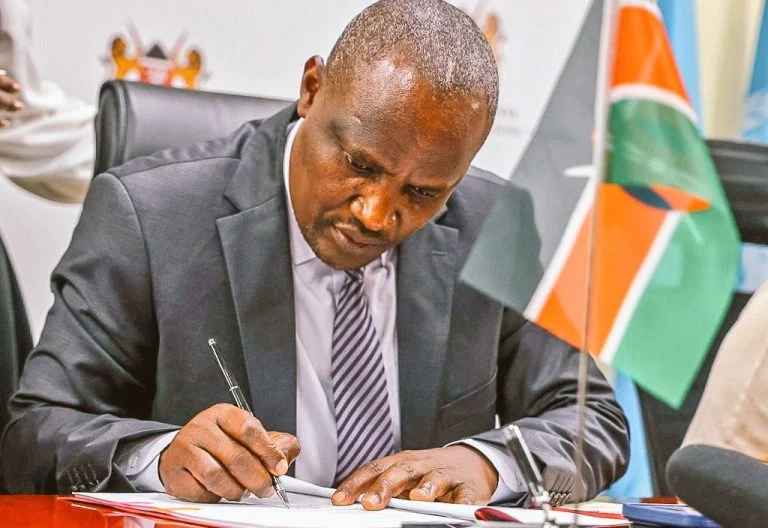
Treasury Cabinet Secretary John Mbadi announced that the proceeds from the sale are expected to be credited to government accounts after the transaction was successfully concluded on the Nairobi Securities Exchange (NSE), bringing to a close a process that had been delayed by legal challenges.
The government sold 6,009,814,200 ordinary shares, representing 15 per cent of Safaricom’s issued share capital, to Vodacom at a price of Sh34 per share. The transaction generated approximately Sh204.3 billion in cash for the Exchequer, making it one of the most significant equity sales undertaken by the Kenyan government.
The sale follows a ruling by the Court of Appeal that lifted conservatory orders which had temporarily halted the transaction, allowing the share transfer to proceed through a block trade on the NSE on June 30.
In addition to the proceeds from the share sale, the transaction includes an advance dividend payment estimated at Sh40.2 billion, secured against the government’s remaining stake in Safaricom. The combined value of the deal is estimated at about Sh244.5 billion.
Following the transaction, Vodacom’s shareholding in Safaricom has increased from 35 per cent to 55 per cent, making it the majority shareholder in Kenya’s largest telecommunications company. The Government of Kenya’s stake has reduced from 35 per cent to 20 per cent, while public investors continue to hold the remaining 25 per cent of the company’s shares.
The Treasury has indicated that the funds will primarily be channelled towards financing long-term development priorities. According to Mbadi, the proceeds are expected to provide seed capital for the proposed National Infrastructure Fund and support the establishment of a Sovereign Wealth Fund, initiatives aimed at reducing the country’s dependence on external borrowing to finance major infrastructure projects.
Government officials have argued that the transaction provides an alternative source of financing for development without increasing public debt, while maintaining that the State will continue to hold a significant strategic interest in Safaricom through its remaining 20 per cent shareholding.
The sale, however, has attracted considerable public and political scrutiny. Critics have questioned the valuation of the shares and raised concerns about the government relinquishing majority ownership in one of the country’s most profitable and strategically important companies. Others have argued that the transaction could have long-term implications for public influence over a key player in Kenya’s telecommunications and digital financial services sectors.
The transaction also faced several court challenges before receiving judicial clearance. Opponents sought to block the sale, citing concerns over public interest and the disposal of State assets. However, the Court of Appeal lifted the conservatory orders, paving the way for the completion of the share transfer.
Safaricom remains Kenya’s largest listed company by market capitalisation and is a major contributor to government revenue through taxes, dividends and other statutory payments. The company also plays a central role in the country’s digital economy through its telecommunications services and mobile money platform, M-PESA.
The completion of the transaction marks a significant shift in Safaricom’s ownership structure while providing the government with one of its largest single inflows of non-tax revenue. Treasury officials have maintained that the proceeds will be directed towards strategic investments intended to support economic growth and strengthen public finances as the government seeks alternative funding sources for development programmes.