

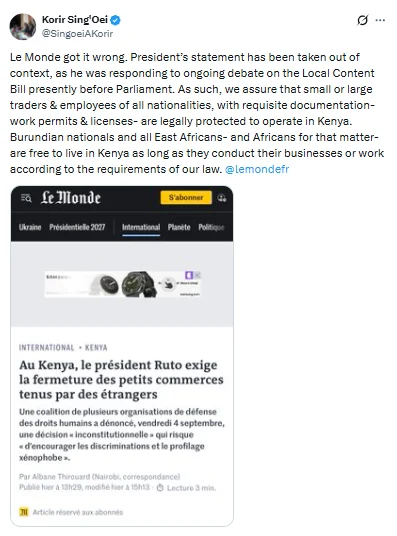
Foreign Affairs Principal Secretary Korir Sing’oei has rejected reports that President William Ruto ordered a blanket crackdown on foreigners operating small businesses in Kenya. Sing’oei said a report by French newspaper Le Monde had taken Ruto’s remarks out of context, arguing that the President was responding to the ongoing debate over the Local Content Bill, 2025, currently before Parliament. In a statement issued on Sunday, September 6, Sing’oei said Kenya remains open to foreign nationals who comply with the country’s laws and possess the necessary documentation. He specifically said both small and large traders, as well as employees of all nationalities, are legally protected if they hold valid work permits and business licences.
Sing’oei’s statement followed a September 5 report by Le Monde suggesting that Ruto had ordered foreign nationals running small-scale businesses to close their operations. The report followed remarks Ruto made on September 2 while addressing Micro, Small and Medium Enterprises traders at State House in Nairobi. Ruto had said the government would take action against foreigners engaged in small-scale businesses, arguing that Kenyan traders should be protected from competition in areas such as hawking and small retail. He also directed the Ministry of Investments, Trade and Industry to begin enforcement measures and referred to legislation before Parliament seeking to regulate foreign participation in certain businesses. Sing’oei, however, said the President’s comments were made in the context of the Local Content Bill debate and should not be interpreted as a directive to expel or shut down all foreign-owned small businesses.
The Foreign Affairs PS said foreign nationals remain free to live and work in Kenya provided they comply with existing legal requirements. He also specifically addressed concerns among Burundian nationals and other East Africans, saying they were free to operate in Kenya as long as their businesses and employment arrangements complied with Kenyan law. The clarification comes amid growing uncertainty among foreign traders following Ruto’s September 2 remarks, particularly among nationals from neighbouring countries who operate small businesses in Nairobi and other urban centres. Sing’oei’s position suggests that the government’s stance is focused on compliance with work permits, licences and other legal requirements rather than a blanket prohibition on foreign traders.
The controversy has also placed renewed attention on the Local Content Bill, 2025, which seeks to increase the participation of Kenyan citizens and businesses in the economy. The government has repeatedly argued that foreign investment remains welcome, particularly where it contributes capital, creates employment and supports local production. At the same time, the administration has faced pressure from Kenyan small-scale traders who say foreign nationals operating in low-capital businesses are competing directly with them.
For now, the government has sought to draw a distinction between regulating foreign participation in certain sectors and banning foreigners from doing business in Kenya. Sing’oei’s clarification means that foreign traders and workers who have valid permits and licences remain legally entitled to operate, while any restrictions arising from proposed legislation would have to be considered through the relevant legal and parliamentary processes.