

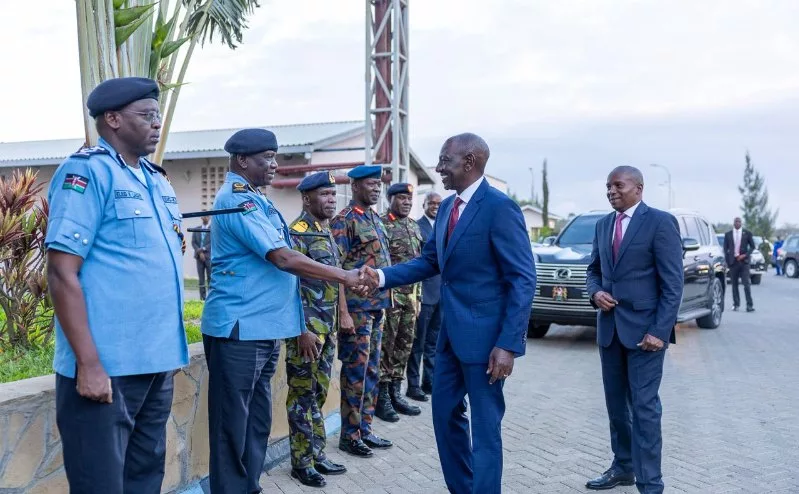
President William Ruto has travelled to Zambia to attend the inauguration of President Hakainde Hichilema, who is set to begin his second five-year term following his re-election in the August 13 presidential election. Ruto departed Nairobi on Tuesday, September 1, and was seen off by Deputy President Kithure Kindiki before travelling to Lusaka for the ceremony. Kenyan media reported that Ruto is among several African leaders and other dignitaries attending the inauguration. The swearing-in ceremony is being held at the National Heroes Stadium in Lusaka, where Hichilema and Vice President-elect Mutale Nalumango are scheduled to take their oaths of office. Zambia’s government had earlier confirmed September 1 as the inauguration date after the seven-day period for filing a presidential election petition expired without a petition being lodged.
Hichilema secured a second term after the Electoral Commission of Zambia declared him the winner of the August 13 election. According to Zambia’s State House, he received 2,965,326 votes, ahead of his closest challenger, Brian Mundubile, who received 1,856,217 votes. The result gives Hichilema another five years to pursue his administration’s agenda. Ruto’s attendance places Kenya among the regional countries represented at the inauguration and provides an opportunity for Nairobi to reinforce its bilateral relationship with Lusaka. Kenya and Zambia have maintained diplomatic relations covering areas including trade, investment, transport, security and regional cooperation. Ruto’s visit comes as both countries continue to engage through broader African and regional institutions.
Kenyan reports described the visit as an opportunity to strengthen cooperation between the two countries and wider regional engagement. Ruto had earlier congratulated Hichilema following his election victory, with the Kenyan presidency highlighting the longstanding relations between the two countries. The two economies also have commercial links, with businesses in both countries participating in cross-border trade within the wider Eastern and Southern African markets.
Hichilema’s inauguration follows a first term marked by efforts to restructure Zambia’s debt, address inflation and stabilise the country’s economy. His government has also prioritised the mining sector, agriculture, education and energy as part of its development agenda. Zambia remains one of Africa’s major copper producers, making its economic policies significant to regional trade and investment. Zambia’s State House has outlined several targets for Hichilema’s second term, including expanding electricity generation, increasing agricultural production, raising copper output and attracting more international tourists.
The country’s economic recovery remains a key issue for the new term. Reuters reported that Hichilema’s re-election has provided investors with greater policy continuity, although Zambia continues to face challenges including energy shortages and the need to translate economic stabilisation into stronger growth and employment.
Hichilema’s inauguration comes after an election that was largely won by the incumbent but also generated controversy from the opposition. The Electoral Commission declared Hichilema the winner with roughly 61 per cent of the vote. His closest challenger, Brian Mundubile, rejected the result and raised allegations concerning irregularities in the electoral process. The inauguration nevertheless proceeds after Zambia’s judiciary received no presidential election petition within the constitutional seven-day period, according to the Zambian Cabinet Office.
For Kenya, Ruto’s presence in Lusaka is primarily a diplomatic engagement, placing him among regional leaders witnessing the formal start of Hichilema’s second mandate. The visit also gives Kenya an opportunity to maintain political and economic engagement with Zambia as Hichilema’s administration begins another five-year term and both countries seek deeper cooperation in trade, investment and regional affairs.