

American television journalist Rob Finnerty has issued an apology to Kenyan people for comparing Nairobi to American cities that he claimed had been “transformed” by immigration, following an online backlash against him.
The Finnerty on Newsmax star’s statement came on Tuesday, October 13, 2026, after the online controversy erupted following his comments on American immigration and the state of US cities that had been affected by the new wave.
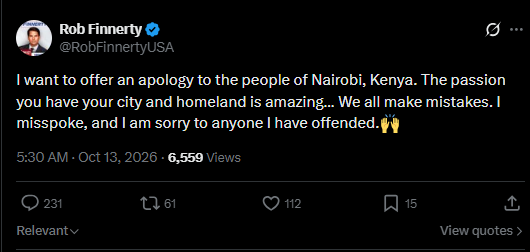
“I want to extend an apology to the people of Nairobi, Kenya. The passion you have for your city and homeland is incredible. We all make mistakes. I got carried away, and I am genuinely sorry to those I offended by my remarks,” the TV host said in a statement.
His comments had sparked an online controversy after he compared Nairobi to New York City and claimed that due to immigration, American cities were becoming more like Nairobi than New York. Finnerty was speaking on a segment about immigration under President Joe Biden and how migrants affected the cities that had adopted sanctuary policies.
“Massive migrations of people from Africa, the Middle East and throughout South America are emptying these countries and moving into blue sanctuary cities, cities that then start to look more and more like Nairobi than like New York City,” he said.
According to The Star and K24 Digital, when discussing how US cities were “transformed” and “bustling” due to immigration, Finnerty showed footage of persons who identified themselves as Guatemalan, Bangladeshi, Burkinabé, Senegalese, Mexican and Guinean.
However, no one in the clip identified themselves as Kenyan, which angered the people of Kenya. There were also claims that Finnerty was using Nairobi as an example of a city that was changing on purpose.
“There were plenty of Kenyans who responded to your piece yesterday calling for your apology, saying that there was no need to pick and single out Nairobi as the town symbolising change for the worse,” wrote one Twitter user.
Soon enough, Kenyan Twitter started trending as people reacted to the segment and shared pictures and videos of Nairobi’s skyline, street life, and upscale suburbs.
“Don’t take pictures in slums of any African city and say it looks like Chicago or any other US city, they are developing and changing for the better,” one Twitter user wrote.
Finnerty’s statement addressed the concerns of Kenyan people but failed to sufficiently explain why he chose Nairobi and compared it to New York City. Nairobi has become a popular destination for migrants, but so do many other cities in Kenya.
His statement shows that the TV host understood the seriousness of the situation and the fact that his words could have been perceived offensively.
“While I believe strongly what I said in the piece, I understand why people may find my remarks about Nairobi offensive and therefore I want to extend an apology to the people of Nairobi,” he said.
Finnery’s controversy ignites a heated debate about Nairobi, which is relevant to Kenya’s most pressing issues. The TV host weighed in on the debate about US Sanctuary Cities and immigration but drew ire for using Nairobi as an example. The fallout also shows the complicated relationship between African nations and news outlets in the Global North.