

A Kenya Airways flight bound for New York returned safely to Nairobi on Monday after the crew detected a technical indication involving the aircraft’s flight control system while flying over Chad.
The aircraft, flight KQ002D, a Boeing 787 Dreamliner operating from Jomo Kenyatta International Airport (JKIA) to John F. Kennedy International Airport (JFK), was forced to cut short its journey after the cockpit received an alert indicating a spoiler malfunction. The crew opted to return to Nairobi to allow engineers to carry out a comprehensive technical assessment of the aircraft.
Kenya Airways confirmed the incident in a statement, saying the decision to turn back was made in line with standard safety procedures and stressing that passenger and crew safety remained the airline’s overriding priority.
“Kenya Airways confirms that flight KQ002D, operating from Nairobi to New York (JFK), experienced a flight controls spoiler malfunction indication while over Chad. As a precautionary measure, the flight returned to Nairobi for technical evaluation,” the airline said.
The carrier said the flight crew carried out all the required safety procedures before making the decision to return, adding that the aircraft landed safely at Jomo Kenyatta International Airport without incident.
“The crew conducted all necessary safety procedures, and the aircraft landed safely at Jomo Kenyatta International Airport. The safety and well-being of our guests and crew remain our highest priority,” Kenya Airways said.
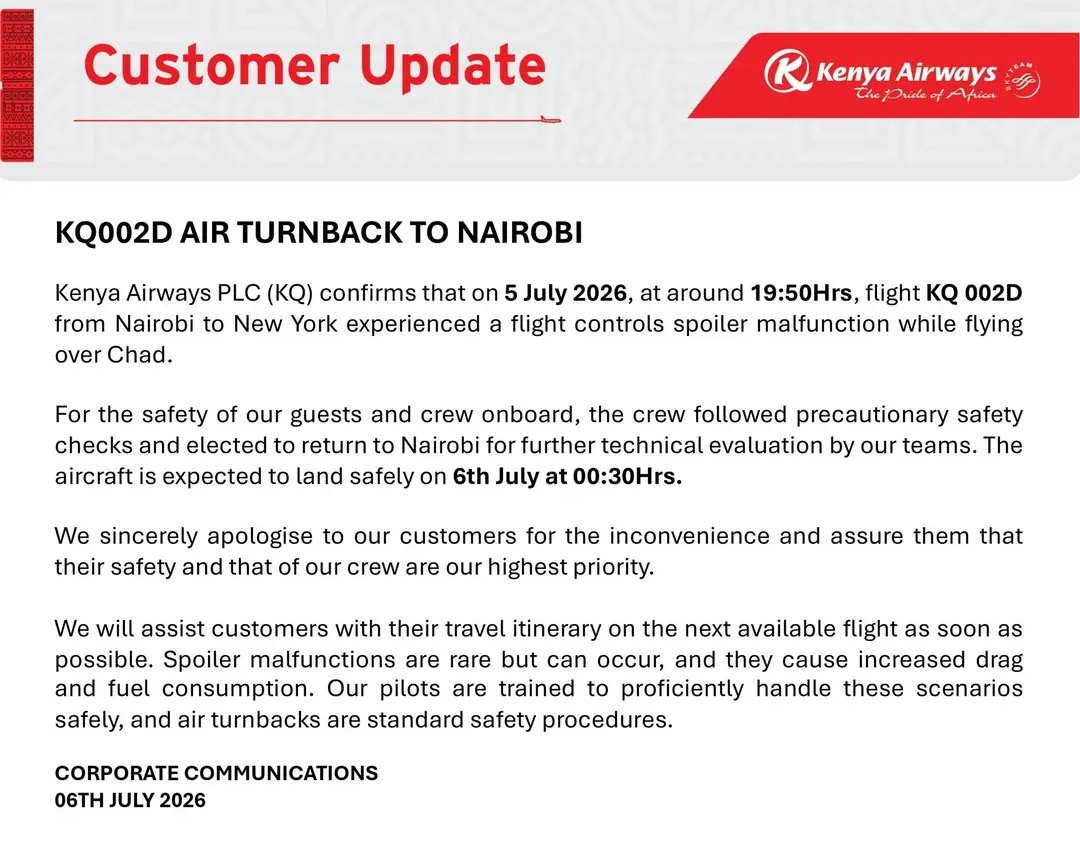
The airline did not report any injuries among passengers or crew and did not indicate that the aircraft had declared an emergency. Instead, it described the return as a precautionary measure to enable its engineering team to inspect the aircraft before it is cleared for further operations.
A spoiler is a movable panel mounted on an aircraft’s wing that helps reduce lift, assists with braking after landing and contributes to the aircraft’s roll control during flight. Aviation experts note that an alert indicating a spoiler malfunction does not necessarily mean the system has failed completely. Modern commercial aircraft, including the Boeing 787 Dreamliner, are equipped with multiple redundant flight control systems designed to maintain safe operation even when a fault is detected.
Returning to the departure airport after a technical alert is a standard safety practice in commercial aviation, particularly on long-haul routes where pilots may choose to have the aircraft inspected by the airline’s maintenance teams before continuing the journey.
Following the aircraft’s safe landing in Nairobi, Kenya Airways engineers began a technical evaluation to determine the cause of the cockpit indication and carry out any necessary maintenance. The airline is also expected to make alternative travel arrangements for affected passengers in accordance with its operational procedures.
The incident underscores the aviation industry’s safety-first approach, where technical warnings are treated with caution to ensure that aircraft are thoroughly inspected before resuming scheduled operations.