

President William Ruto says more than 500,000 surgeries have been carried out and over 50,000 cancer patients treated through Kenya’s Social Health Authority (SHA), highlighting the figures as part of his administration’s progress in the health sector. Ruto said the figures were recorded as the government implements reforms aimed at expanding access to healthcare and advancing its Universal Health Coverage (UHC) agenda. The President cited the numbers while reviewing his administration’s performance in the health sector, where the government has made the transition from the former National Hospital Insurance Fund (NHIF) to SHA a central part of its healthcare reforms.
SHA was established under the Social Health Insurance Act, 2023, as part of a broader restructuring of Kenya’s health financing system. The new framework created three funds: the Social Health Insurance Fund, the Primary Healthcare Fund and the Emergency, Chronic and Critical Illness Fund. The transition was intended to shift Kenya towards a system in which access to healthcare is not determined solely by a person’s ability to pay at the point of treatment. The surgery figure is significant because specialised procedures can place a substantial financial burden on patients and their families, particularly when treatment requires prolonged hospitalisation and follow-up care.
Ruto has presented increased access to specialised medical services as one of the areas where the new system is expected to make a difference. Cancer treatment has also been a major focus of the reforms. In his 2025 State of the Nation address, Ruto said the government would increase the SHA cancer benefits package from KSh550,000 to KSh800,000, effective December 1, 2025. He said the increase was intended to strengthen financial protection for patients undergoing prolonged cancer treatment. The government has also identified cancer prevention, screening and treatment as priorities within the national health sector framework, with targets covering screening and early diagnosis services.
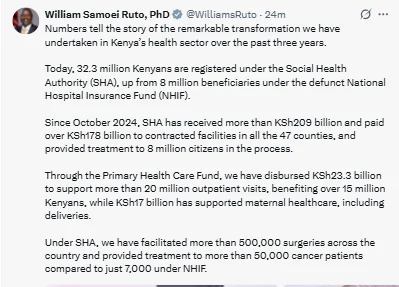
SHA formally replaced NHIF as Kenya’s new health insurance framework, following the enactment of the Social Health Insurance Act and related health laws in 2023. The reforms were accompanied by changes to how Kenyans contribute towards health insurance and how healthcare services are financed. The system uses the Social Health Insurance Fund for insurance-based services, while the Primary Healthcare Fund is intended to support primary care and the Emergency, Chronic and Critical Illness Fund to cater for specified specialised and emergency needs. The government has argued that the model will make healthcare more accessible, particularly for households that previously struggled to meet medical costs.
Ruto’s latest figures therefore form part of the government’s broader account of its health-sector performance rather than an independent assessment of the overall effectiveness of SHA.
The health reforms are part of Ruto’s wider UHC agenda, which seeks to increase access to affordable and quality healthcare while reducing the amount households pay directly for treatment. The administration has also linked the reforms to changes in primary healthcare, digital health systems and the financing of public health facilities. For patients, the practical significance of the SHA transition will ultimately depend on whether they can access the services they need when they need them, whether facilities are adequately equipped and staffed, and whether claims and payments to healthcare providers are processed efficiently. Ruto’s announcement places the latest surgery and cancer-treatment figures at the centre of the government’s case that the health reforms are expanding access to specialised care.
The President said the progress recorded over the past three years demonstrates the direction of the reforms as Kenya continues its push towards Universal Health Coverage.