

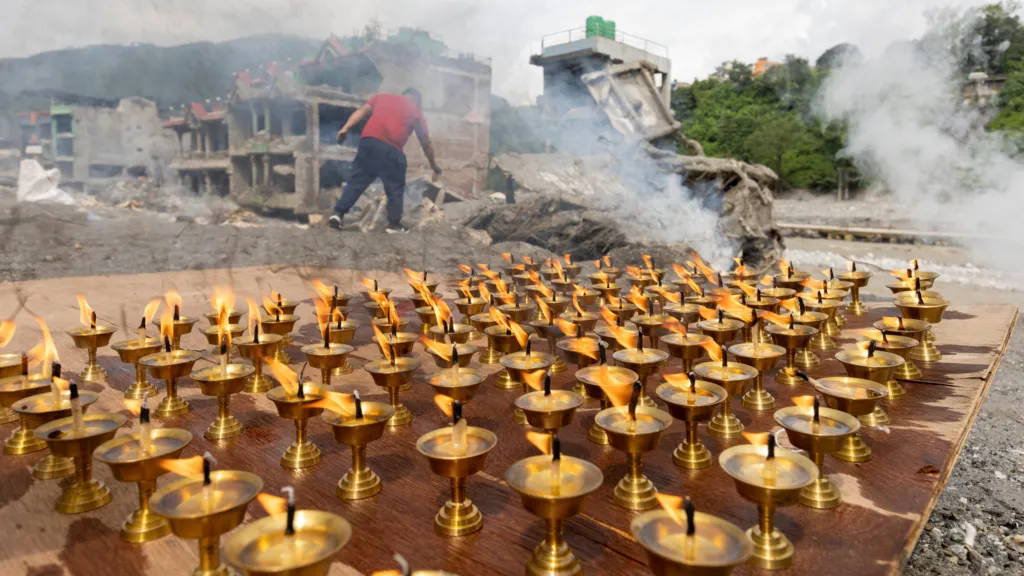
Nepal observed a national day of mourning on Monday, September 7, for victims of devastating flash floods that struck the Bhote Koshi river basin and surrounding northern districts on August 26. Government offices across Nepal and Nepali diplomatic missions abroad flew the national flag at half-mast as the country marked the 13th day since the disaster, in accordance with traditional Hindu mourning practices. The government said 1,355 bodies had been recovered by Monday, while around 5,000 people remained missing. The figures remain subject to verification as search and identification operations continue.
Despite the national mourning observance, emergency operations continued in some of the worst-affected areas. The Nepali Army, Nepal Police, Armed Police Force and disaster-management authorities remain involved in search, rescue and relief operations across Rasuwa, Nuwakot, Dhading and other affected districts. International teams from India, China and South Korea are working alongside Nepali forces on tunnel rescue operations, while teams from the United Arab Emirates and Malaysia have also joined the effort. Drones, rescue equipment and other specialised machinery are being deployed at damaged hydropower facilities. Authorities are particularly focused on several hydropower projects, including Upper Trishuli 1, Upper Trishuli 3A, Upper Trishuli 3B, Chilime, Rasuwagadhi and Langtang, where workers remain unaccounted for. Rescuers have continued to find survivors nearly two weeks after the floods.
Nepal’s Foreign Ministry said four people had been rescued alive in the four days preceding Monday, including two Nepali workers recovered from the Upper Trishuli 3A tunnel, a Chinese national rescued from Upper Trishuli 1 and another Nepali national found in a house in Betrawati. The discoveries have kept hopes alive for people still trapped in tunnels and other isolated locations. Families of missing people, however, continue to demand faster and more extensive searches, particularly at hydropower facilities where workers may have been trapped underground.
The scale of the disaster has prompted assistance from several countries and international organisations. Nepal said it had received support from India, China, the United Kingdom, United States, Japan, Australia, South Korea, Malaysia, the United Arab Emirates and other countries, as well as the United Nations, World Bank and Asian Development Bank. Specialised teams are assisting with tunnel searches, forensic identification and other emergency operations. Nepal has also requested additional equipment, including high-capacity drones, LiDAR systems, tunnel-rescue suits, DNA-testing kits and heavy pumping equipment.
The national mourning day came as authorities continued restoring roads, bridges, electricity and telecommunications in affected areas. The Nepali Army and engineers are working to restore the Galchhi–Trishuli Road, including construction of a temporary bridge over the Tadi River, while authorities work to reconnect communities cut off by the floods. For families of those who died or remain missing, however, the disaster is far from over. As Nepal observed its traditional 13th day of mourning, rescue teams continued searching tunnels, rivers and damaged infrastructure for survivors and remains, while forensic teams worked to identify recovered bodies and return them to their families for final rites.