

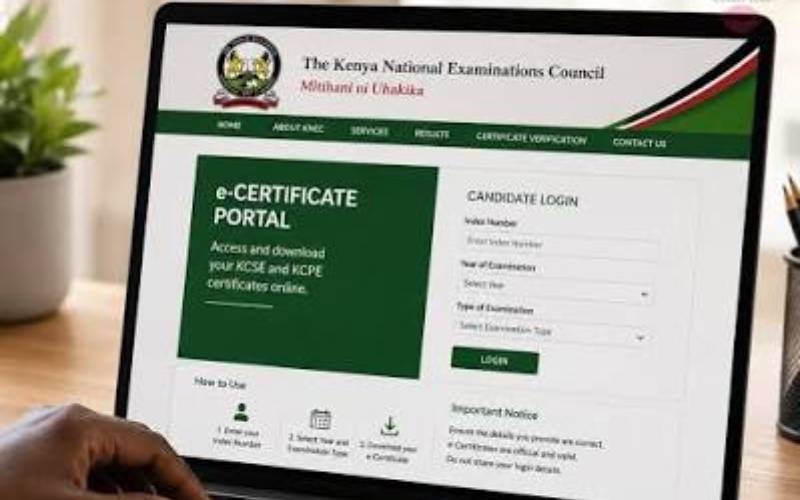
The Kenya National Examinations Council (KNEC) has outlined the process through which candidates can access their primary and secondary school examination certificates online following the rollout of its new e-Certificate platform, a digital service designed to simplify certificate retrieval and strengthen document verification.
The online platform allows holders of Kenya Certificate of Primary Education (KCPE) and Kenya Certificate of Secondary Education (KCSE) certificates to obtain digital copies of their examination credentials without relying solely on physical documents. At the same time, employers, universities and other institutions can use the system to verify the authenticity of certificates presented by applicants.
According to KNEC, the platform is intended to improve access to examination credentials while reducing the risk of certificate fraud through secure digital verification.
“The e-Certificate system provides candidates with a digital way of accessing their examination certificates and organisations with a secure platform for verifying their authenticity,” KNEC said.
How candidates can access their certificates
KNEC said candidates must first create an account on the e-Certificate portal by providing their personal details and completing the required identity verification process.
Applicants are then required to:
- Register using the official e-Certificate portal.
- Verify their identity using the information requested by KNEC.
- Select the examination certificate they wish to access.
- Complete the authentication process before retrieving the digital certificate.
Once verification is complete, the certificate becomes available through the online platform.
The council noted that the system has been developed with security features intended to ensure that certificates are accessed only by their rightful holders.
Online verification for institutions
In addition to serving candidates, the platform enables authorised organisations to verify examination certificates presented for employment, admission, professional registration and immigration purposes.
Instead of relying on manual confirmation procedures, institutions can authenticate certificates electronically through the portal, allowing them to confirm whether a document was issued by KNEC.
The council says the verification service is expected to improve efficiency while helping employers and academic institutions detect forged academic credentials more quickly.
Part of KNEC’s digital transformation
The introduction of the e-Certificate system forms part of KNEC’s broader efforts to digitise examination services and modernise the management of academic records.
For years, certificate verification has largely depended on physical documentation and manual confirmation processes, which could be time-consuming for both certificate holders and institutions. The new platform is expected to shorten verification timelines while providing a more secure method of confirming academic qualifications.
KNEC has also maintained that physical certificates already issued remain valid and that the digital platform is intended to complement existing records rather than immediately replace them.
Addressing certificate fraud
The council has increasingly adopted technology to combat examination certificate fraud, including digital verification tools and enhanced authentication measures. The latest platform is expected to strengthen confidence in Kenyan academic qualifications by providing a centralised and secure verification system.

KNEC has encouraged candidates seeking digital access to their certificates, as well as employers and learning institutions requiring verification services, to use the official platform and follow the registration procedures outlined by the council.
The rollout of the e-Certificate system is expected to improve access to examination records while supporting more efficient verification of academic credentials across education, employment and other sectors where proof of qualifications is required.