

The Energy and Petroleum Regulatory Authority (EPRA) has reduced the maximum retail price of diesel by KSh5 per litre, while leaving the prices of Super Petrol and kerosene unchanged for the August 15 to September 14, 2026 pricing cycle. The revised prices take effect from midnight on Saturday, August 15, and will remain in force until September 14, 2026.
In a statement issued on Friday following its monthly fuel price review, EPRA said the adjustment was made in accordance with the Petroleum Act, 2019, and the petroleum pricing regulations governing the determination of maximum pump prices across the country.
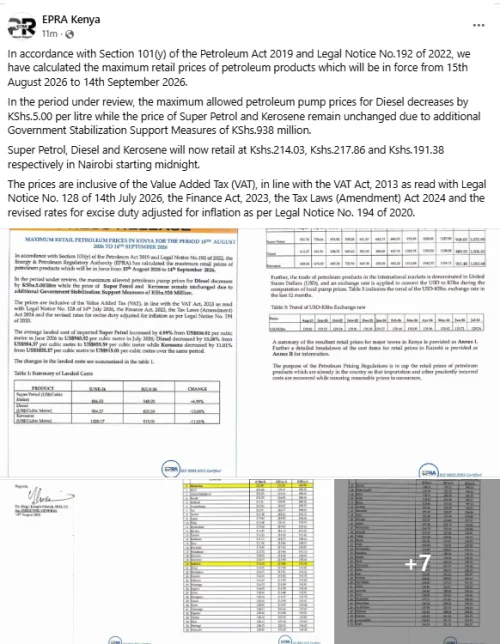
“The maximum allowed petroleum pump prices for Diesel decrease by Sh5.00 per litre while the price of Super Petrol and Kerosene remain unchanged due to additional Government Stabilisation Support Measures of Sh938 million,” EPRA said.
Under the new pricing schedule, motorists in Nairobi will pay a maximum of KSh214.03 per litre for Super Petrol, KSh217.86 per litre for Diesel, and KSh191.38 per litre for Kerosene. Prices in other parts of the country will vary slightly to reflect transport and distribution costs, as provided for under the pricing formula.
The regulator attributed the diesel price reduction to a decline in the average landed cost of imported diesel during the review period. According to EPRA, the average landed cost of diesel fell by 13.08 per cent, from US$984.37 per cubic metre in June 2026 to US$855.59 per cubic metre in July 2026.
By contrast, the landed cost of imported Super Petrol increased by 6.99 per cent, rising from US$836.92 to US$894.92 per cubic metre, while the landed cost of kerosene declined by 11.01 per cent, from US$1,028.17 to US$915.01 per cubic metre over the same period.
Despite the increase in petrol import costs, consumers will not pay more at the pump after the government extended fuel price stabilization measures. EPRA said the government provided an additional KSh938 million through its stabilization programme to cushion consumers against higher international fuel costs and maintain petrol and kerosene prices at their current levels.
The latest review is expected to provide some relief for sectors that rely heavily on diesel, including public transport, freight and logistics, agriculture, manufacturing and construction. Diesel is widely used by commercial vehicles, heavy machinery and power generators, meaning lower pump prices could help reduce operating costs for businesses, although the impact on transport fares and consumer prices will depend on decisions made by individual operators.
EPRA reviews fuel prices every month based on several factors, including international petroleum prices, the average landed cost of imported fuel, the exchange rate, taxes, levies and distribution margins. The authority is mandated to set maximum retail pump prices under Kenya’s petroleum pricing framework.
The regulator also noted that the published prices are inclusive of Value Added Tax (VAT) and other applicable taxes and levies provided for under Kenyan law.
The August–September review follows last month’s decision to retain prices for all three fuel products. The latest adjustment means diesel users will see a reduction at the pump, while motorists using petrol-powered vehicles and households that rely on kerosene will continue paying the same prices until the next monthly review, unless EPRA announces fresh changes.