

Andy Burnham has been appointed Prime Minister of the United Kingdom after King Charles III asked him to form a government following the resignation of Keir Starmer.
Burnham formally assumed office on 20 July 2026, becoming the UK’s new head of government after Starmer stepped down as Labour leader and prime minister in the wake of mounting political pressure following Labour’s poor performance in recent local and devolved elections.
Under the UK’s constitutional system, a prime minister who resigns first tenders their resignation to the monarch. The monarch then invites the political leader most likely to command the confidence of the House of Commons to form a government.
Following his audience with King Charles III at Buckingham Palace, Burnham travelled to 10 Downing Street, where he delivered his first address as prime minister and outlined the immediate priorities of his administration.
“Our task now is to govern in the national interest and deliver for people across every part of the United Kingdom,” Burnham said in his first speech outside Downing Street.
Burnham said his government would focus on addressing the cost of living, economic growth, housing, public services and further devolution of powers to regional authorities.
His appointment marks a return to national office after serving as Mayor of Greater Manchester since 2017. Before becoming mayor, Burnham held several senior Cabinet positions under previous Labour governments, including Health Secretary and Culture Secretary, and represented Leigh as a Member of Parliament for 16 years.
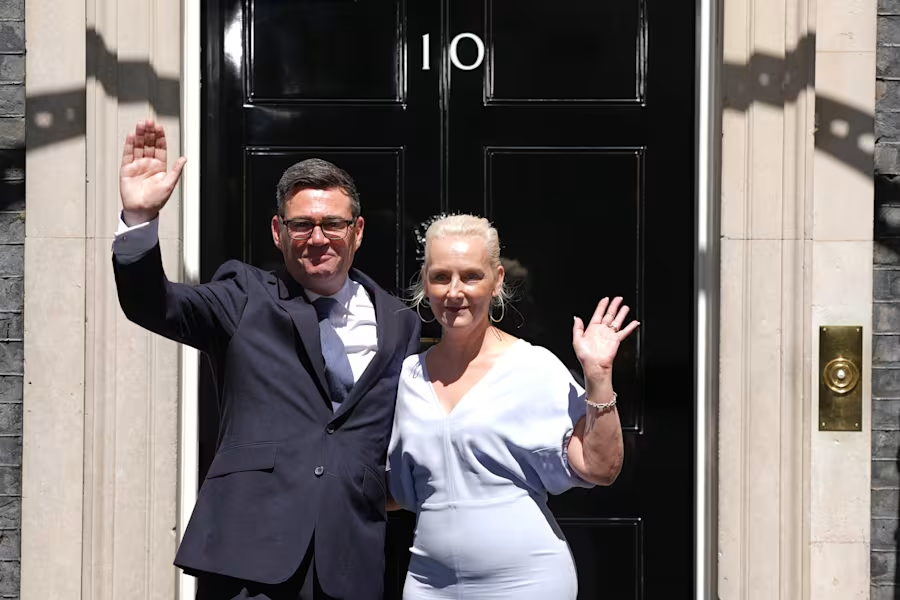
Shortly after taking office, Burnham announced his first Cabinet appointments. John Healey was named Chancellor, Ed Miliband became Foreign Secretary, Wes Streeting was appointed Defence Secretary, Yvette Cooper became Health Secretary, while Louise Haigh was appointed First Secretary of State and Chancellor of the Duchy of Lancaster.
The leadership transition followed Keir Starmer’s decision to resign after Labour’s disappointing electoral performance. In his resignation statement, Starmer said the party required new leadership.
“It has been the privilege of my life to serve as Prime Minister. I believe this is the right time for the party to move forward under new leadership,” Starmer said.
Burnham now takes office at a time when the UK government faces several domestic policy challenges, including economic growth, pressure on public services, housing supply and regional development. His administration is also expected to set out its legislative programme and spending priorities in the coming weeks.
The change in leadership does not alter the composition of Parliament, where Labour continues to hold government. Instead, it represents a change in party leadership following Starmer’s resignation.
Burnham’s first responsibilities as prime minister include appointing ministers, overseeing the transition to the new administration and preparing the government’s legislative agenda for Parliament.
His appointment makes him the latest leader to head the UK government during a period of frequent political leadership changes, with attention now shifting to the policies his administration will pursue and how it intends to address the country’s economic and public service priorities.