

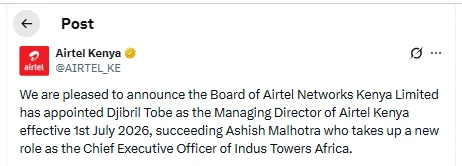
Airtel Kenya has appointed telecommunications executive Djibril Tobe as its new Managing Director, marking a leadership transition at the country’s second-largest mobile network operator as it seeks to sustain growth in an increasingly competitive telecommunications market.
Tobe officially assumes office on July 1, 2026, succeeding Ashish Malhotra, who is leaving the company after four years to take up the position of Chief Executive Officer at Indus Towers Africa.
The appointment places Tobe at the helm of Airtel Kenya at a time when the company continues to expand its mobile, broadband and digital financial services while competing for a larger share of Kenya’s telecommunications market. Before his appointment, Tobe served as Managing Director of Airtel Congo Brazzaville, where he oversaw the company’s commercial and operational activities. He brings more than two decades of experience in the telecommunications industry, having held senior leadership positions across several African markets.
His previous roles include Managing Director of Airtel Chad, Commercial Director at Airtel Burkina Faso, and Chief Executive Officer of Expresso Guinea. His career has also included experience in consulting and the fast-moving consumer goods sector, providing him with a broad background in business strategy, commercial operations and organisational leadership.
Airtel Kenya said the appointment is intended to strengthen the company’s leadership as it continues investing in network expansion, digital services and customer experience.
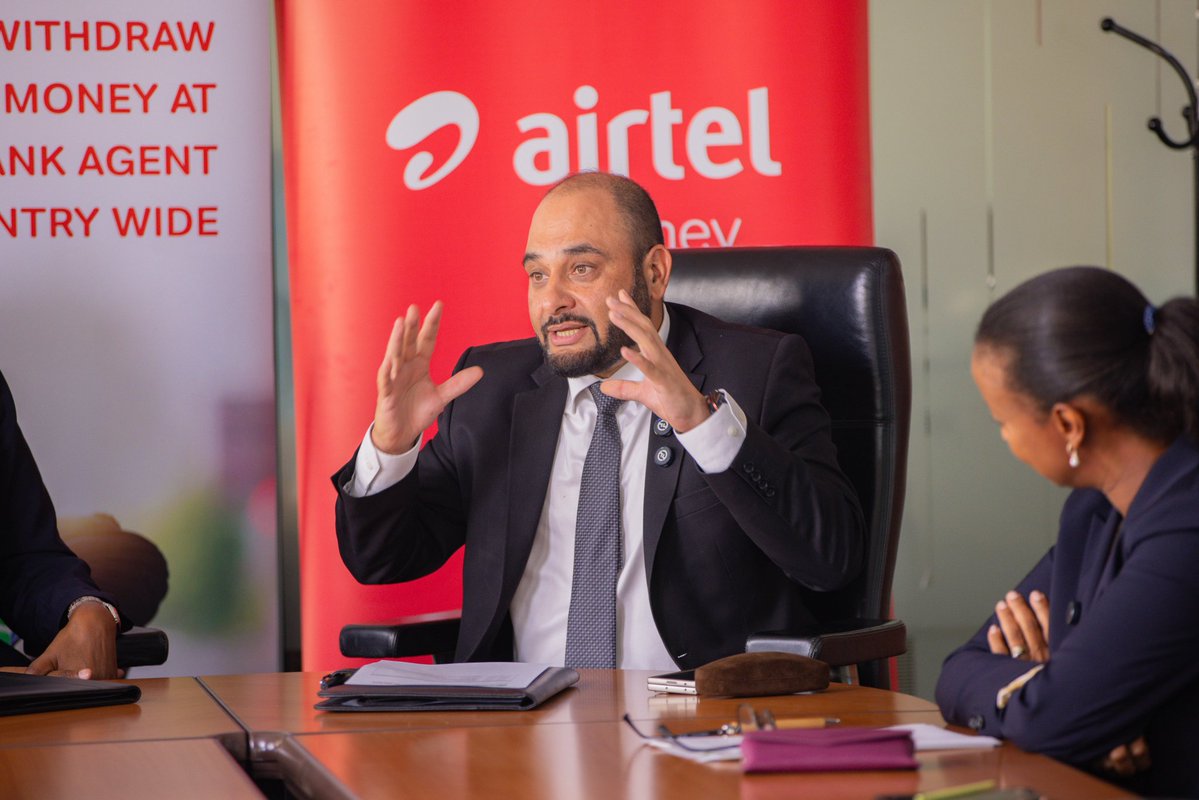
Tobe takes over a business that has undergone significant transformation under Malhotra’s leadership. During his tenure, Airtel Kenya accelerated investment in network infrastructure, expanded 4G and 5G coverage, introduced eSIM technology and strengthened its fibre broadband offering as demand for high-speed internet services continued to grow.
The company also expanded the reach of Airtel Money, increasing its presence in Kenya’s mobile financial services market through new partnerships, product innovations and wider agent distribution. These efforts contributed to growth in Airtel’s subscriber base and reinforced its position as the country’s second-largest telecommunications operator.
The leadership transition comes at a time when Kenya’s telecommunications sector is experiencing rapid technological change, driven by increasing smartphone adoption, higher demand for digital financial services, expansion of fibre connectivity and continued rollout of fifth-generation (5G) mobile networks.
Competition among operators has also intensified as companies invest heavily in network quality, affordable data packages and digital platforms to attract and retain subscribers in a market where consumer expectations continue to evolve.
Industry analysts view leadership changes within major telecommunications firms as significant because of the sector’s strategic role in Kenya’s digital economy. Mobile network operators continue to support critical services ranging from financial transactions and e-commerce to education, healthcare and public service delivery.
Tobe is expected to oversee Airtel Kenya’s next phase of growth as the company pursues further investment in network infrastructure, expands digital products and strengthens customer-focused services. His appointment also reflects Airtel Africa’s continued emphasis on drawing leadership talent from within its regional operations to support its expansion strategy across the continent.
Malhotra leaves Airtel Kenya after overseeing one of the company’s most active investment periods. His move to Indus Towers Africa concludes a tenure characterised by infrastructure expansion, technological upgrades and efforts to increase competition within Kenya’s telecommunications industry.
The change in leadership comes as Airtel Kenya seeks to consolidate recent gains while positioning itself for future growth in a market that remains central to East Africa’s digital transformation. With demand for reliable connectivity and digital services continuing to rise, the company is expected to maintain its focus on expanding coverage, improving service delivery and strengthening its presence across key segments of the telecommunications industry.
