

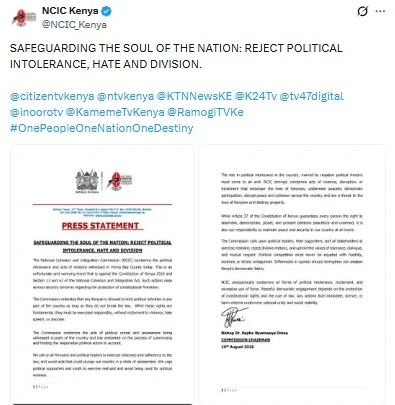
The National Cohesion and Integration Commission (NCIC) has condemned violence reported during the Linda Mwananchi political activities in Homa Bay County, warning that continued political intolerance could push Kenya towards lawlessness. In a statement issued on Sunday, August 16, 2026, NCIC Chairperson Bishop Kepha Nyamweya Omae described the incidents as an “unfortunate and worrying trend” and said they were contrary to the Constitution and the National Cohesion and Integration Act. The commission said political competition must not be allowed to undermine citizens’ constitutional rights or threaten peace and security.
NCIC’s intervention came after chaotic scenes were reported as the Linda Mwananchi movement conducted political activities in different parts of Homa Bay on Sunday. Reports included road blockades, confrontations and disruption along the movement’s route. The Star reported that tear gas was also lobbed at the convoy as it moved through the county, forcing crowds to disperse and supporters to clear sections of the road that had been obstructed with stones. The commission said it would take steps to summon political actors linked to the incidents as it seeks to establish responsibility for the violence. The move places the events under closer scrutiny from a national institution mandated to promote peaceful coexistence and address issues relating to ethnic tension, discrimination and political intolerance.
NCIC has not, however, declared any particular political leader guilty of causing the violence. Any individuals suspected of committing criminal offences would still have to be investigated and, where appropriate, prosecuted through the established legal process. The commission’s warning comes as political mobilisation increases ahead of the 2027 General Election, raising renewed concerns about the potential for political competition to develop into violence. NCIC stressed the importance of protecting citizens’ right to participate in political activities.
Article 37 of the Constitution guarantees the right of every person to assemble, demonstrate, picket and present petitions peacefully and unarmed. That right applies regardless of a person’s political affiliation or the part of the country where a political gathering is being held. At the same time, constitutional freedoms do not provide protection for violence, destruction of property or intimidation. The NCIC warning therefore places responsibility on both political leaders and their supporters to ensure that political mobilisation remains peaceful and within the law.
The commission’s position also comes amid concerns over the use of groups of young people to disrupt political gatherings. The violence has also raised concerns about the safety of journalists covering political events. Reports from Homa Bay indicate that journalists were caught up in the unrest, with media crews reportedly assaulted and equipment stolen while covering the Linda Mwananchi activities. Siaya Governor James Orengo on Monday condemned what he described as targeted attacks on journalists from several media organisations.
Amnesty International Kenya also condemned the reported violence, citing attacks on journalists, disruption of media broadcasts, destruction of property and road blockades. The organisation called for prompt, independent and impartial investigations into the incidents and urged authorities to establish whether there were failures by security agencies to prevent or respond effectively to foreseeable violence. The Homa Bay incidents were preceded by warnings over security arrangements surrounding the political activities.
Authorities had raised concerns about the possibility of civilian groups being used to provide security during political gatherings, while political actors had called on the police to guarantee the safety of participants. The developments highlight the difficulty of maintaining public order during increasingly competitive political activities, particularly where rival groups converge in the same area. For NCIC, the immediate concern is that political disagreements could develop into broader hostility and undermine peaceful participation in public affairs. The commission’s intervention is likely to increase pressure on security agencies and political leaders to establish what happened, who was responsible and whether any offences were committed.
Kirinyaga Woman Representative Njeri Maina has separately called on NCIC, the Directorate of Criminal Investigations and the Office of the Director of Public Prosecutions to investigate the violence and take action against those found responsible. The calls for investigations come as political leaders increasingly position themselves ahead of the 2027 elections. For residents, and businesses in Homa Bay, the immediate issue is restoring normalcy and ensuring that political activity does not expose them to violence or intimidation.
NCIC’s warning therefore places the Homa Bay incidents within a broader national concern over political intolerance. The commission says the events should not become a pattern as Kenya approaches another election cycle. Its decision to summon political actors will now be closely watched, particularly whether the process identifies individuals responsible for violence and whether the findings lead to further action.