

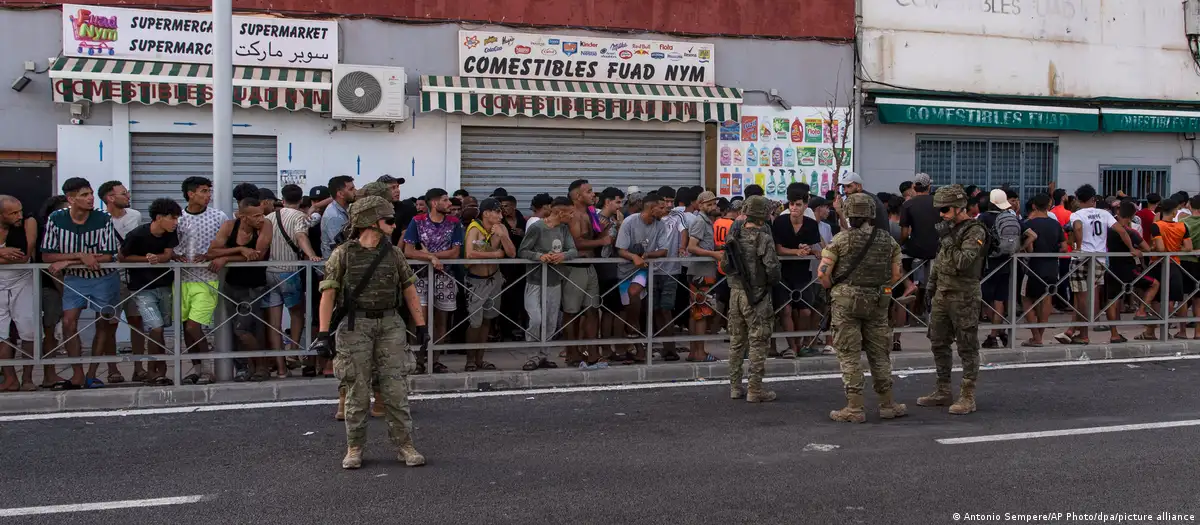
Spain has deployed additional military personnel to its North African enclave of Ceuta after thousands of migrants crossed into the territory from Morocco on Thursday, July 30, prompting a major security operation and renewed cooperation between Madrid and Rabat to manage the influx.
Spanish authorities said many of the migrants reached Ceuta by swimming around coastal barriers or using small boats to cross the narrow stretch of water separating Morocco from the Spanish territory. The sudden arrivals overwhelmed local border controls and reception facilities, leading the government to reinforce security with military support alongside the Guardia Civil and National Police.
The deployment marks one of Spain’s largest responses to an irregular migration surge in Ceuta since the 2021 border crisis, when thousands of migrants entered the enclave within 48 hours.
Spain’s Interior Minister, Fernando Grande-Marlaska, travelled to Ceuta on Thursday to oversee the government’s response and announced that Spanish and Moroccan authorities were working together to restore normal border operations.
“The situation is under control, and cooperation with Morocco is functioning well,” Grande-Marlaska told reporters during his visit to Ceuta, adding that security forces had been reinforced to manage the influx and maintain public order.
Spanish officials said the operation also involves processing new arrivals, providing emergency humanitarian assistance and identifying those eligible for return under existing migration agreements between Spain and Morocco.
The latest crossings also turned deadly. Rescue teams recovered several bodies from the waters near Ceuta after migrants attempted the dangerous journey by sea. Spanish emergency services continued search and rescue operations while authorities worked to establish the identities of those who died.
The exact number of fatalities remains subject to official confirmation as rescue efforts continue.
Ceuta, together with the Spanish enclave of Melilla, represents one of the European Union’s only land borders with Africa. The territory has long been a focal point for migrants seeking entry into Europe, particularly during periods of heightened migration pressure or diplomatic tensions between Spain and Morocco.
The latest incident has once again placed the spotlight on migration routes across the western Mediterranean and the challenges facing European border management.
Spanish Prime Minister Pedro Sánchez’s government has maintained that border security must be accompanied by close cooperation with neighbouring countries, particularly Morocco, which plays a central role in controlling migration flows towards Europe.
The European Commission has repeatedly described Spain’s external borders as part of the European Union’s common frontier, underscoring the importance of coordinated efforts to combat irregular migration while respecting international humanitarian obligations.
Commenting on the latest developments, a European Commission spokesperson said the bloc was closely monitoring the situation and remained in contact with Spanish authorities.
“We stand in solidarity with Spain in protecting the European Union’s external border while ensuring that international obligations are fully respected,” the spokesperson said.
The surge bears similarities to the migration crisis of May 2021, when approximately 8,000 migrants entered Ceuta after Moroccan border controls were temporarily eased during a diplomatic dispute between the two countries. Spain deployed the military during that crisis and subsequently returned thousands of migrants to Morocco under bilateral agreements.
While authorities have not linked the latest influx to any political dispute, officials from both Spain and Morocco have pledged continued cooperation to strengthen border management and facilitate the return of migrants who do not qualify for international protection.
The Spanish government said security deployments in Ceuta will remain in place as authorities continue processing arrivals, monitoring the border and coordinating with Moroccan counterparts to prevent further mass crossings.