

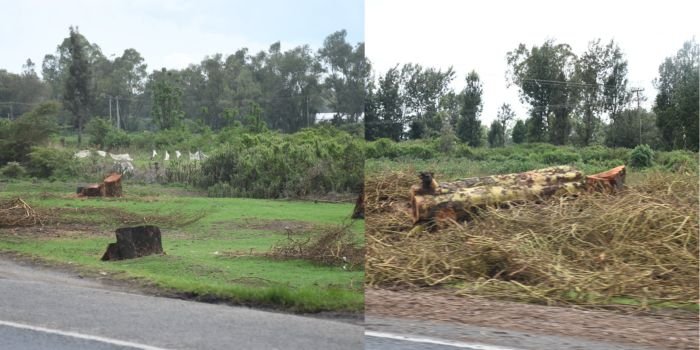
Nairobi Governor Johnson Sakaja has ordered enforcement action against officials from the Kenya Urban Roads Authority (KURA), the Kenya National Highways Authority (KeNHA) and Kenya Power, accusing the agencies of cutting down trees in the city without obtaining the approval required from the Nairobi City County Government.
The directive followed an inspection of an ongoing tree-felling exercise linked to infrastructure works within the city. Sakaja said the county had not authorized the removal of the trees and instructed county enforcement officers to stop the exercise while action is taken against those found to have violated the county’s procedures.
“Nobody is above the law. If you want to cut down trees in Nairobi, you must seek approval from the county government,” Sakaja said during the inspection.
The governor maintained that the county supports infrastructure development but said projects involving the removal or pruning of public trees must comply with applicable legal and regulatory requirements before any work begins.
The agencies named by the governor are responsible for road construction, highway development and electricity infrastructure across the country. According to the county government, the tree-cutting was being undertaken as part of ongoing public infrastructure projects. However, Sakaja said the works proceeded without the county’s approval.
“Development must go hand in hand with environmental protection. We cannot allow trees to be cut without following the law,” he said.
The dispute highlights the respective roles of national agencies and county governments in managing public infrastructure and environmental protection. While agencies such as KURA, KeNHA and Kenya Power implement road and utility projects, county governments are responsible for regulating activities affecting public spaces within their jurisdictions and enforcing local environmental and planning requirements.
Under Kenya’s environmental and planning framework, projects involving the removal of trees may require approvals from the relevant authorities depending on the location, land ownership and the scope of the works. County governments are also mandated to oversee compliance with local planning and environmental regulations.
The incident has renewed attention on the protection of Nairobi’s urban tree cover, which has come under pressure from expanding road and utility projects. Environmental experts have consistently argued that mature trees play an important role in improving air quality, reducing urban temperatures, managing stormwater and supporting biodiversity, making proper approval processes essential before trees are removed.
As of publication, KURA, KeNHA and Kenya Power had not publicly responded in detail to the governor’s allegations or confirmed whether the necessary county approvals had been obtained before the exercise commenced.