

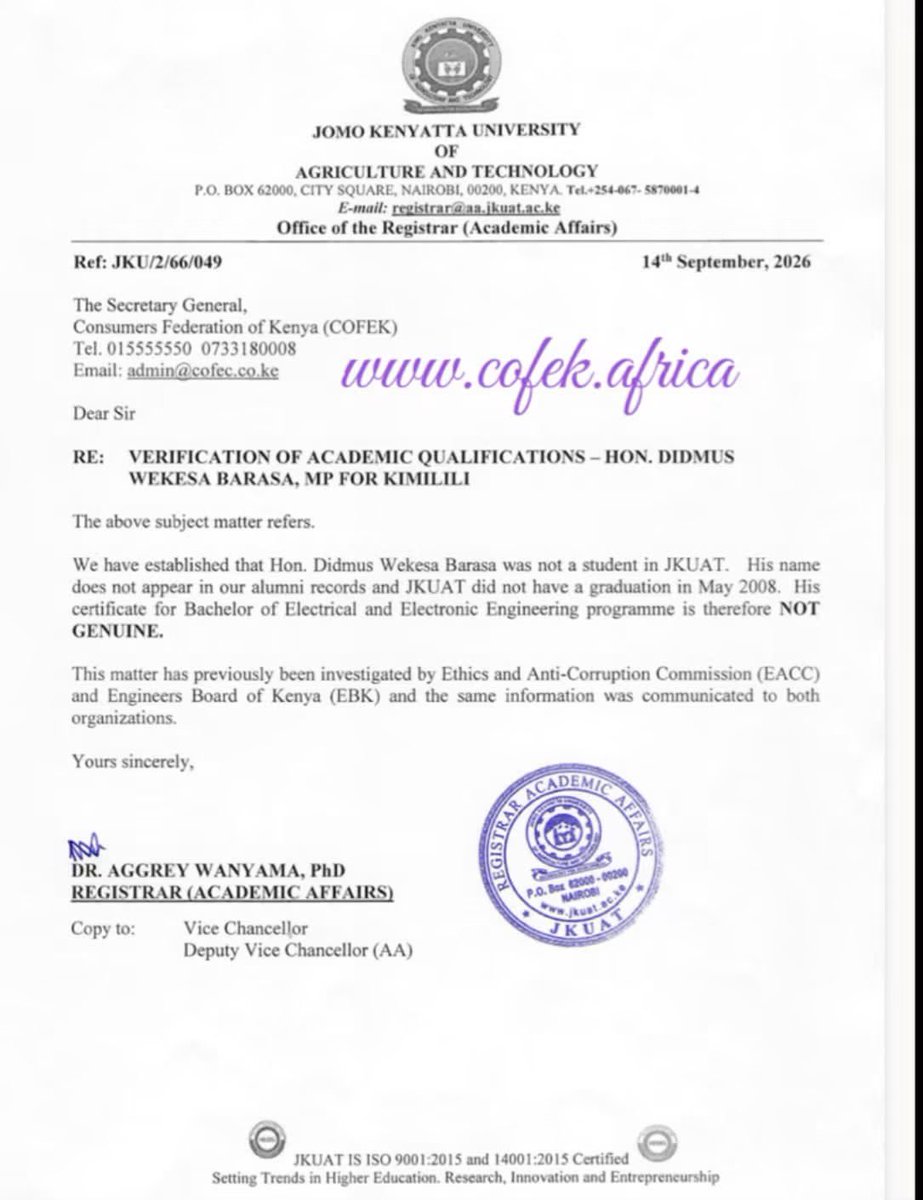
Jomo Kenyatta University of Agriculture and Technology (JKUAT) has disputed the academic credentials of Kimilili Member of Parliament Didmus Wekesa Barasa, saying he was never a student at the university and was not awarded a Bachelor’s degree in Electrical and Electronic Engineering. The university made the disclosure in a letter dated September 14, 2026, addressed to the Consumers Federation of Kenya (COFEK). JKUAT Registrar of Academic Affairs Dr Aggrey Wanyama said the university had checked its records and found no evidence that Barasa studied at the institution or graduated from its programmes.
“His name doesn’t appear on our alumni records, and JKUAT did not have a graduation in May 2008. His certificate for Bachelor of Electrical and Electronic Engineering Programme is therefore ‘NOT GENUINE,’” Wanyama said in the letter.
According to JKUAT, there was no graduation ceremony at the university in May 2008, further contradicting the information appearing on the disputed qualification. The university said the matter was not new and that its findings had previously been communicated to the Ethics and Anti-Corruption Commission (EACC) and the Engineers Board of Kenya (EBK).
“This matter has previously been investigated by the Ethics and Anti-Corruption Commission (EACC) and Engineers Board of Kenya (EBK), and the same information was communicated to both organisations,” Wanyama said.
The university’s position has brought renewed attention to conflicting versions of Barasa’s academic history appearing on Parliament’s website. One parliamentary profile previously listed Barasa as having obtained a Bachelor of Science in Electrical and Electronic Engineering from JKUAT between 2001 and 2005, alongside postgraduate qualifications from Australian universities. However, the current version of Barasa’s parliamentary profile lists different qualifications. It shows a Diploma in Electrical and Electronics Engineering from the Kenya Power & Lighting Training School, now the Institute of Energy Studies, followed by a Bachelor of Arts in Public Administration and a Master of Arts in Public Administration and Management from Mount Kenya University. The differing records have added to questions surrounding the engineering qualification that JKUAT says it did not award.
COFEK has called for greater accountability from institutions that may previously have dealt with questions surrounding Barasa’s academic credentials. COFEK Secretary General Stephen Mutoro challenged EACC, EBK and the Commission for University Education (CUE) to explain what action they took after receiving information from JKUAT.
“EACC and EBK owe Kenyans a public accounting of what they did with JKUAT’s finding, and when the Council of University Education approve it,” Mutoro said, according to TUKO.
The available reports do not establish what action, if any, the three institutions have taken following the latest JKUAT confirmation. Barasa had not provided a substantive response by the time of its report. The publication said the MP later shared a photograph of himself wearing a graduation gown accompanied by a brief message, but did not publicly address JKUAT’s specific allegations in that response. The latest development concerns the specific JKUAT engineering qualification and does not by itself determine the validity of Barasa’s other academic qualifications. The matter also does not establish what happened during previous investigations by EACC or EBK. Those agencies would need to explain their findings and any action taken.
For now, JKUAT’s official position is that Barasa’s name does not appear in its alumni records, that the university did not hold a graduation ceremony in May 2008, and that the Bachelor of Electrical and Electronic Engineering certificate attributed to him is “NOT GENUINE.” The disclosure is likely to place renewed focus on the verification of academic and professional qualifications held by public officials, as relevant regulatory agencies face questions over their handling of the earlier concerns.