

Kenya’s system for monitoring pesticide safety contains significant weaknesses that could leave consumers exposed to food containing unsafe pesticide residues, according to a new performance audit by the Office of the Auditor-General.
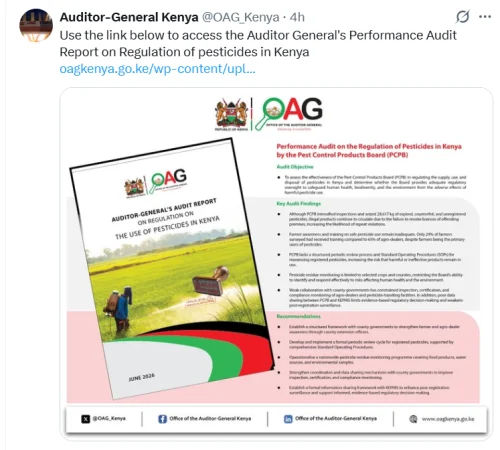
The audit, which assessed the country’s framework for regulating pesticides and monitoring their impact, found that the Pest Control Products Board (PCPB) has carried out limited pesticide residue surveillance and lacks comprehensive scientific data on the presence and effects of pesticide residues in food, water and the environment.
According to the report, the shortcomings limit the country’s ability to provide consistent assurance that food available to consumers complies with established safety standards.
“The Pest Control Products Board has conducted limited residue monitoring and lacks comprehensive scientific data on the safety of pesticides and their impact on food, water and the environment,” the Auditor-General’s performance audit states.
The report does not conclude that food in Kenya is generally unsafe. Instead, it warns that weaknesses in the monitoring system make it difficult for regulators to determine whether pesticide residues consistently remain within acceptable safety limits.
The audit found that residue testing has been limited in scope, leaving significant gaps in the data required to assess consumer exposure to pesticides. It also noted that the regulator has insufficient information on the long-term effects of pesticide use on public health, water resources, soil quality and biodiversity.
The Pest Control Products Board, the statutory body mandated to regulate the importation, manufacture, distribution, sale and use of pest control products in Kenya, is responsible for ensuring that registered pesticides meet safety requirements and are used appropriately. However, the audit found that the board’s monitoring activities have not generated enough scientific evidence to provide a comprehensive picture of pesticide residue levels across the country.
Pesticide residue monitoring is an internationally recognised food safety practice that involves testing agricultural produce to determine whether chemical residues remain within legally permitted Maximum Residue Limits (MRLs). These limits are established to ensure that food reaching consumers does not contain pesticide concentrations considered unsafe for human consumption.
Without regular and extensive monitoring, regulators may face challenges in identifying contaminated food products, evaluating compliance with pesticide regulations and responding promptly to emerging public health risks.
The Auditor-General also highlighted the need for stronger coordination among government institutions involved in agriculture, public health, environmental protection and food safety. The report indicates that improved collaboration would strengthen surveillance systems and enhance the country’s capacity to monitor pesticide use throughout the food production chain.
Among its recommendations, the audit calls for the expansion of nationwide pesticide residue testing, investment in laboratory capacity and the development of comprehensive scientific databases to support evidence-based regulation. It also urges the relevant agencies to improve data collection on the environmental and health effects of pesticide use.
The findings come as Kenya continues to rely heavily on pesticides to protect crops from pests and diseases, with agriculture remaining one of the country’s largest economic sectors. While pesticides play an important role in improving agricultural productivity, regulators are expected to ensure that their use does not compromise food safety or environmental sustainability.
Food safety experts have long maintained that effective residue monitoring is essential for protecting consumers, facilitating agricultural exports and maintaining confidence in Kenya’s food systems. Regular surveillance also enables authorities to identify non-compliant products and take corrective action before they reach the market.
The Auditor-General’s report underscores the need for stronger scientific monitoring rather than suggesting widespread contamination of food supplies. Its central finding is that Kenya requires more robust surveillance systems and better evidence to assess pesticide residues and safeguard public health.
The recommendations contained in the audit are expected to inform future regulatory improvements by the Pest Control Products Board and other government agencies responsible for food safety and environmental protection as they work to strengthen oversight of pesticide use across the country.