

Spain have been crowned 2026 FIFA World Cup champions after defeating defending champions Argentina 1-0 after extra time in a closely contested final at MetLife Stadium in East Rutherford, New Jersey.
Substitute Ferran Torres scored the decisive goal in the 106th minute, finishing from close range after Nico Williams headed Pedro Porro’s cross into his path. The goal settled a tense encounter and handed Spain their second FIFA World Cup title, 16 years after their maiden triumph in South Africa. The victory also made Spain the first nation to win FIFA’s expanded 48-team World Cup.
The final remained goalless after 90 minutes despite Spain controlling much of the play. Luis de la Fuente’s side finished with 20 shots to Argentina’s two, but repeatedly found goalkeeper Emiliano Martínez in inspired form before finally breaking the deadlock in extra time. (Reuters)
Argentina’s hopes of retaining the trophy suffered a major setback at the end of normal time when midfielder Enzo Fernández was sent off after receiving a second yellow card, forcing Lionel Scaloni’s side to play the entire extra-time period with 10 men.
Spain capitalised on the numerical advantage, and Torres’ finish ultimately proved enough to separate the two sides in a final decided by fine margins.
Speaking after the victory, Spain head coach Luis de la Fuente praised his players for the unity that underpinned their successful campaign.
“We are the most united team. These players have extraordinary values and they deserve everything they have achieved,” De la Fuente said after the match.
Torres, who was named the Player of the Match, dedicated the victory to Spain’s supporters.
“The goal belongs to 47 million Spaniards. It wasn’t mine alone. Today destiny was written for us to become world champions,” he said after collecting the award.
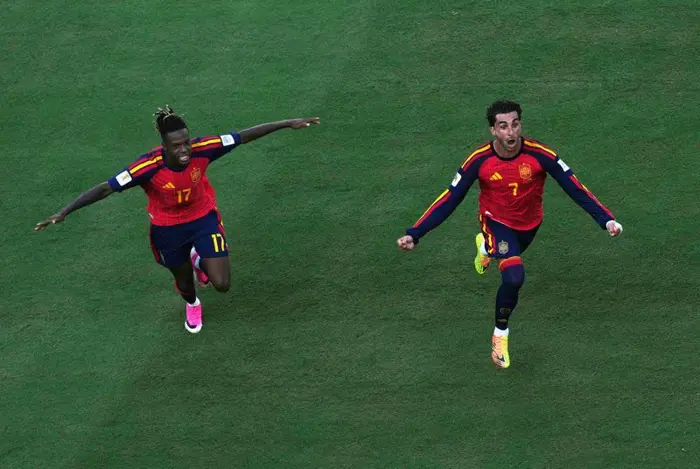
Spain’s triumph caps an impressive period under De la Fuente, who has now guided the national team to both the UEFA European Championship and the FIFA World Cup. At 65, he also became the oldest coach to win the men’s World Cup.
For Argentina, the defeat ended their bid to become the first country since Brazil in 1962 to successfully defend the FIFA World Cup title. It also marked what many expect could be Lionel Messi’s final World Cup appearance, although the Argentina captain has not announced whether he will continue his international career.
The final brought the curtain down on the first men’s World Cup to feature 48 teams, with the tournament hosted jointly by the United States, Canada and Mexico. FIFA expanded the competition from 32 to 48 nations, introducing a new format that increased the number of participating teams and matches.
Spain completed the tournament unbeaten, producing a balanced campaign built on disciplined defending, effective ball control and clinical finishing in key moments. Their victory restores them to the summit of world football for the first time since 2010 and concludes a tournament that showcased both established stars and emerging talent on the global stage.
For Argentina, the loss ends a successful reign as world champions after lifting the trophy in Qatar four years ago. While Scaloni’s side fell short in their attempt to retain the title, their run to a second consecutive final reaffirmed their place among international football’s leading nations.
Spain, meanwhile, leave North America with the sport’s biggest prize, becoming only the ninth country to win the FIFA World Cup and the first champions of the tournament’s new 48-team era.