

Agriculture Cabinet Secretary Mutahi Kagwe has announced plans to transform Kenya’s sugar industry by enabling state-owned sugar factories to generate electricity and produce ethanol alongside sugar, in a move aimed at improving the sector’s financial sustainability and reducing the country’s dependence on sugar sales alone.
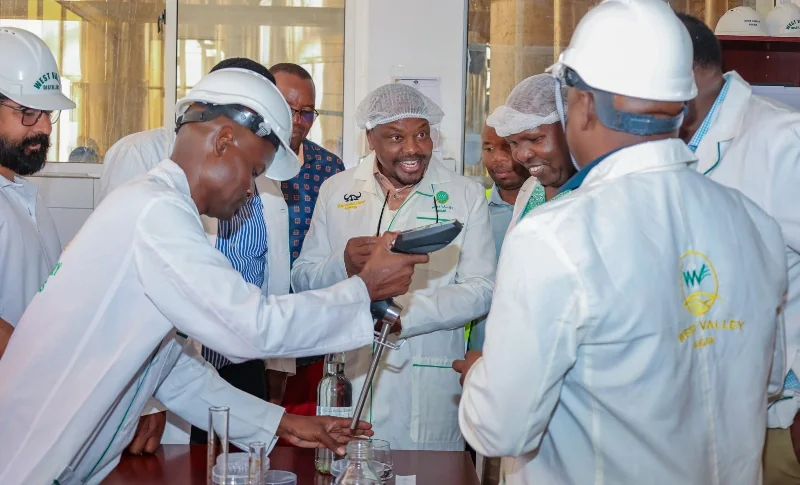
Speaking during an inspection tour of sugar factories in the Western Kenya sugar belt, Kagwe said the government is pursuing reforms that will allow millers to maximise the value of sugarcane by investing in co-generation and ethanol production, creating additional revenue streams for struggling factories.
The Cabinet Secretary said many sugar-producing countries have diversified their industries by converting by-products such as bagasse into electricity and molasses into ethanol, allowing factories to remain profitable even when sugar prices fluctuate.
“Our sugar factories should not rely on sugar alone. They should generate electricity, produce ethanol and fully utilise every part of the sugarcane crop to strengthen their operations,” Kagwe said.
Bagasse, the fibrous material left after sugarcane is crushed, can be used as fuel to generate electricity, while molasses can be processed into industrial and fuel-grade ethanol.
According to Kagwe, expanding these activities would help improve the financial position of sugar factories, lower operational costs and create new sources of income that can support cane farmers and factory workers.
The government believes the approach will also increase the competitiveness of Kenya’s sugar industry, which has faced years of financial challenges, ageing infrastructure and competition from imported sugar. The announcement forms part of wider reforms being implemented in the sugar sector following the leasing of several state-owned sugar factories to private operators under long-term concession agreements.
The government has argued that private investment, combined with operational reforms and diversification, will modernise the industry, improve factory efficiency and ensure farmers receive timely payment for sugarcane deliveries.
Officials say the reforms are intended to revive production while positioning sugar factories as integrated agro-industrial enterprises capable of producing multiple commercial products rather than relying solely on refined sugar.
If implemented successfully, the co-generation programme could enable sugar factories to supply surplus electricity to the national grid while reducing their own energy costs.
At the same time, increased ethanol production could support Kenya’s growing demand for industrial alcohol and biofuel, creating additional opportunities for manufacturing and reducing reliance on imports.
The proposal also aligns with the government’s broader strategy of promoting value addition in agriculture by ensuring that every component of harvested crops contributes to economic output.
Kenya’s sugar sector has undergone repeated restructuring over the past decade as successive governments sought to address mounting debts, declining production and inefficiencies in state-owned mills.
Kagwe said the latest reforms are intended to build a more resilient and commercially viable industry capable of supporting farmers, attracting investment and contributing more significantly to the country’s economy.
Should the plans be fully implemented, Kenya’s sugar factories would increasingly operate as integrated processing hubs, producing sugar, electricity and ethanol, rather than traditional milling plants, a shift the government believes could secure the industry’s long-term sustainability.
